How Lumos Electric Cuts Costs Through High-Rise Value Engineering
An interview with some of our favorite electricians
Electricians are known in construction as a follow trade. But what happens when you bring electrical contractors in at the design stage of a development, rather than in the midst of construction?
Savings. That’s what happens.
We’ve seen it for ourselves in projects like 685 1st Ave and 1001 6th Ave, working with the team that founded Lumos Electric. Since those early projects, and now running their own company, Lumos’s founders have consistently impressed. We had to learn more.
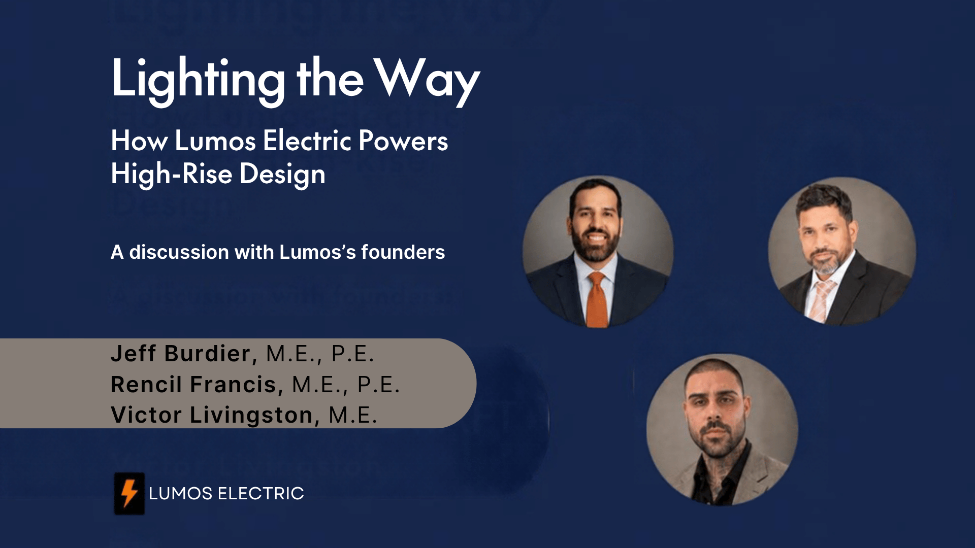
Over the summer, we met with Victor Livingston and Jeff Burdier (the third co-founder, Rencil Francis, was off running the business) about how they approach development projects. We wanted to find out how Lumos creates that most unlikely combination – consistent, high-spec work at lower cost.
Meet Lumos Electric: An NYC Electrical Contractor
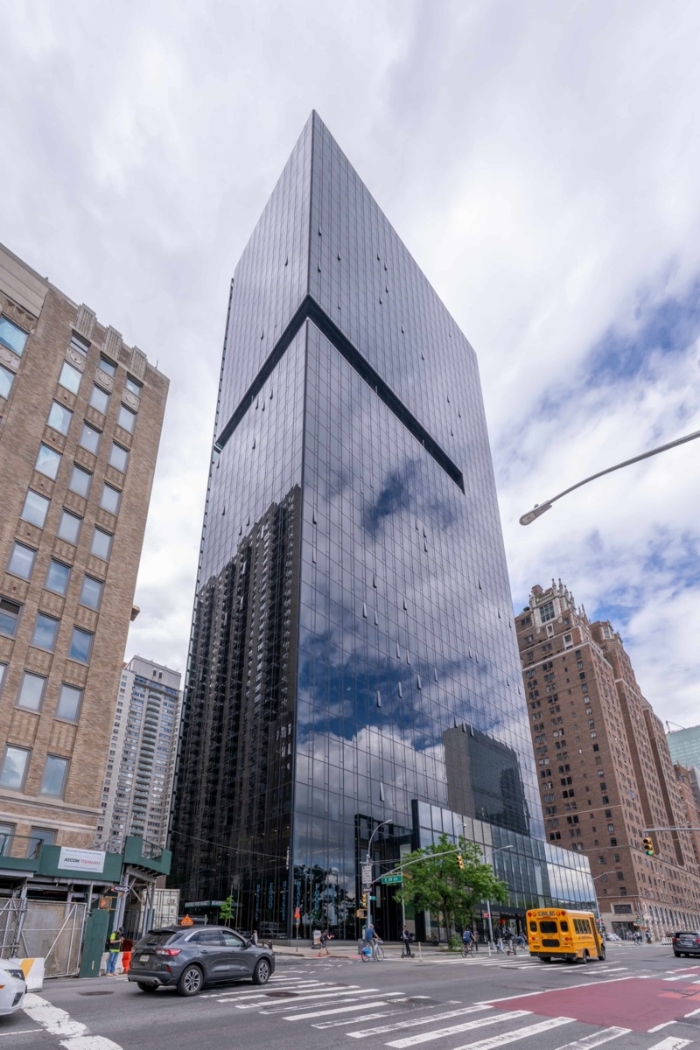
Lumos is an engineer- and management-driven electrical contractor that works in high-rise new construction throughout New York City and the surrounding areas. The company is known for the quality and speed of its work and its ability to lower costs through value engineering.
“The biggest value we provide starts long before the installation,” said Livingston. “Our teams look at constructability, electrical design, utility coordination, the selection of the equipment, the phasing, and long-term building operations, not just putting the conduit in the ground. We purposely stay involved early with owners, developers, engineers, and construction managers so we can solve problems before they become expensive field issues. Clients bring us in because they know we'll think like an owner and not just a subcontractor.”
What Is Value Engineering?
Value engineering means many things to many people. Often, people use it to mean deleting components to save costs. Lumos, in contrast, optimizes their part in the building from design to delivery. “The idea is not just cost savings but also efficiency, which saves on aspects of timeline and schedule, not just for us, but for our clients,” Livingston said.
How Electrical Design and Prefabrication Accelerate Construction
Lumos’s distinctive approach came from the founders’ value-engineering their own business. They looked at where they can work ahead when they aren’t needed, which keeps their own team’s schedules more consistent and lowers Lumos’s internal costs.
“We think through all the aspects of the project,” Burdier said. “When we’re designing an electrical installation, we have our engineering hat on as well as our contractor hat and our installer’s hat. We look at optimizing the distribution and the installation of the equipment. We recalculate loads based on purchased equipment to resize and reduce unintended equipment redundancies in electrical distribution and feeders. We even redesign branch circuitry and evaluate alternate equipment manufacturers. An efficient design improves the installation.”
“We've learned that we can get a lot of our work done before the carpenter is even on site: we put conduits in the slab, we run feeders and panels with the concrete deck so that during superstructure, we're ahead of all the other trades,” he added.
After eight years, Lumos has dialed in its process of coordinating trades, scheduling, and working ahead. “We’ve found the sweet spot with regard to what we complete in the shop, ready for install, vs. what’s done directly in the field,” said Livingston. “We’re now able to accelerate schedules, which, as a follow trade, is not the norm.”
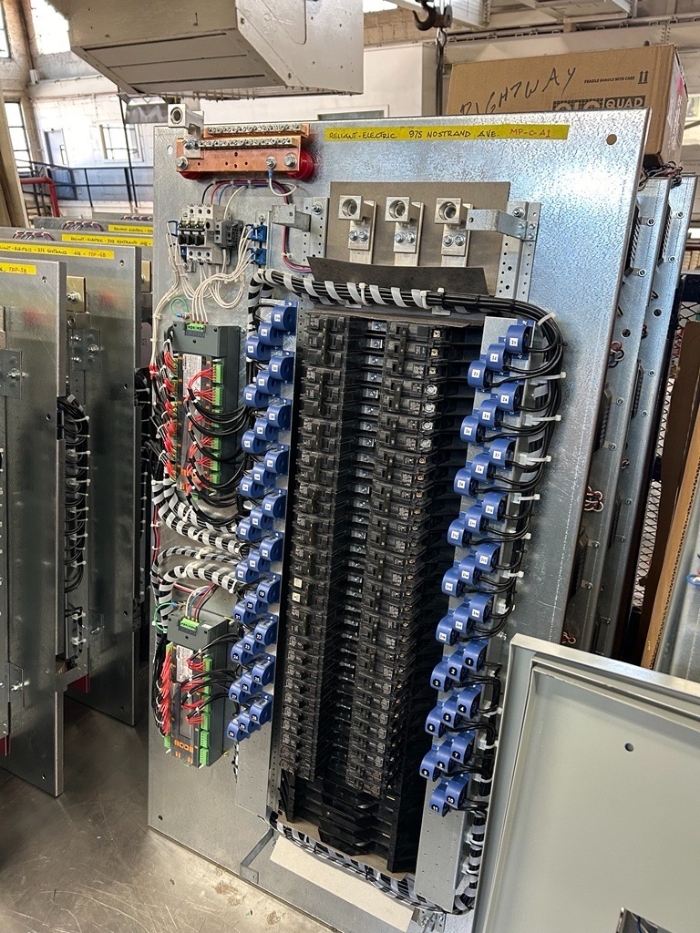
That mindset evolved into one of Lumos’s most recognizable advantages: prefabrication. Livingston likened their system to a prepackaged LEGO set. “When our material goes to the job site, it’s packaged for an individual floor, labeled for the specific apartment, so when it gets there, it’s brought to exactly where it needs to be, and then it’s installed. So there's no searching, there's no worrying about missing pieces or anything like that.”
Proving the Value of Early Electrical Planning
Not every developer immediately embraces Lumos’s approach, so there is skepticism to overcome. “Our developers always ask us to prove how we can make a job more efficient. And it’s not that they don't believe; they may not have experience working with us yet,” Livingston pointed out.
Typically, Lumos shows its designs to a new developer during the bidding process, so the developer can understand what Lumos is recommending. The approach has paid off.
“Over the last seven or eight years, we’ve been able to prove our worth to ourselves and our clientele,” said Livingston. “Our idea isn’t just cost savings but also efficiency, which shortens timelines and schedules – not just for us but also for our clients. The relationships take time. You have to do the right thing and prove that the honesty, the transparency, and the execution are there.”
New Opportunities in Residential Conversions and Electrification
Even though Lumos’s approach is gaining notice, its founders say their biggest opportunities are emerging from broader changes in the market itself. Covid significantly disrupted CRE, but Livingston and Burdier say they’re seeing the commercial market rebound with its shift to residential conversions. Coincidentally, these spaces often reliably benefit from value engineering because the loads are usually fixed, allowing Lumos to quickly work out the most efficient installation design.
The other opportunity, they say, is the push toward electrification. Across the country, building codes are requiring electrical appliances. Now, what used to be supplied by the building has moved inside the residence, changing how properties are managed as well as how square footage is organized and allocated.
How Electrical Design (and Submetering) Frees Up Sellable Space
Moving appliances inside the tenant spaces may sound better for owners. But it adds complexity, says Burdier, especially when it comes to metering. (We didn’t even prompt him to say this, we swear!) “Meter banks take up a lot of space. Submetering systems take up less square footage, which is a big value added, because that’s more space the developer can sell.
Burdier smiled. “On one job, we saved 50 square feet per floor, and the building was 35 stories. Our work ended up returning another $2 million in sales over the entire building. And if we had been brought in sooner on that job, we might have been able to get them 75 square feet per floor. That’s how we create value for our clients.”
For details, see our article (below) on Anthony Calicchio's Lessons in Developing Luxury Real Estate.
How Lumos Earns Developers’ Trust
It’s projects like these that are earning Lumos’s reputation, and we can attest to the quality of their work. Meanwhile, Lumos continues its patient explanations to unfamiliar developers.
“We can tell you that we have a little bit more experience in engineering, but until you see it firsthand, you don't trust us. You don't trust that we can do what we say we can do. So, at the end, we show you what we can do, and then gain your trust, gain the developers and the GC's trust, and that's pretty much it,” he said.
You Might Like
Related articles from our blog:
About utiliVisor
Your tenant submetering and energy plant optimization services are an essential part of your operation. You deserve personalized energy insights from a team that knows buildings from the inside out, applies IoT technology and is energized by providing you with accurate data and energy optimization insights. When you need experience, expertise, and service, you need utiliVisor on your side, delivering consistent energy and cost-saving strategies to you. What more can our 45+ years of experience and historical data do for you? Call utiliVisor at 212-260-4800 or visit utilivisor.com