How We Reference-Test Meters
Valid submeter data matters for your operational bottom line. Are you sure yours is correct?
Metering is the foundation of accurate cost recovery and strategic planning. Without it, you can't be sure your tenant bills are right or that your operational decisions are based on something real. And if they're not, how much time and money is that going to cost you?
In an earlier piece, we talked about the many causes of inaccurate meter readings. It’s a big list.
Rather than hunting for that needle in a haystack every time, we recommend reference testing to confirm your meters are functioning well and meet your lease terms.
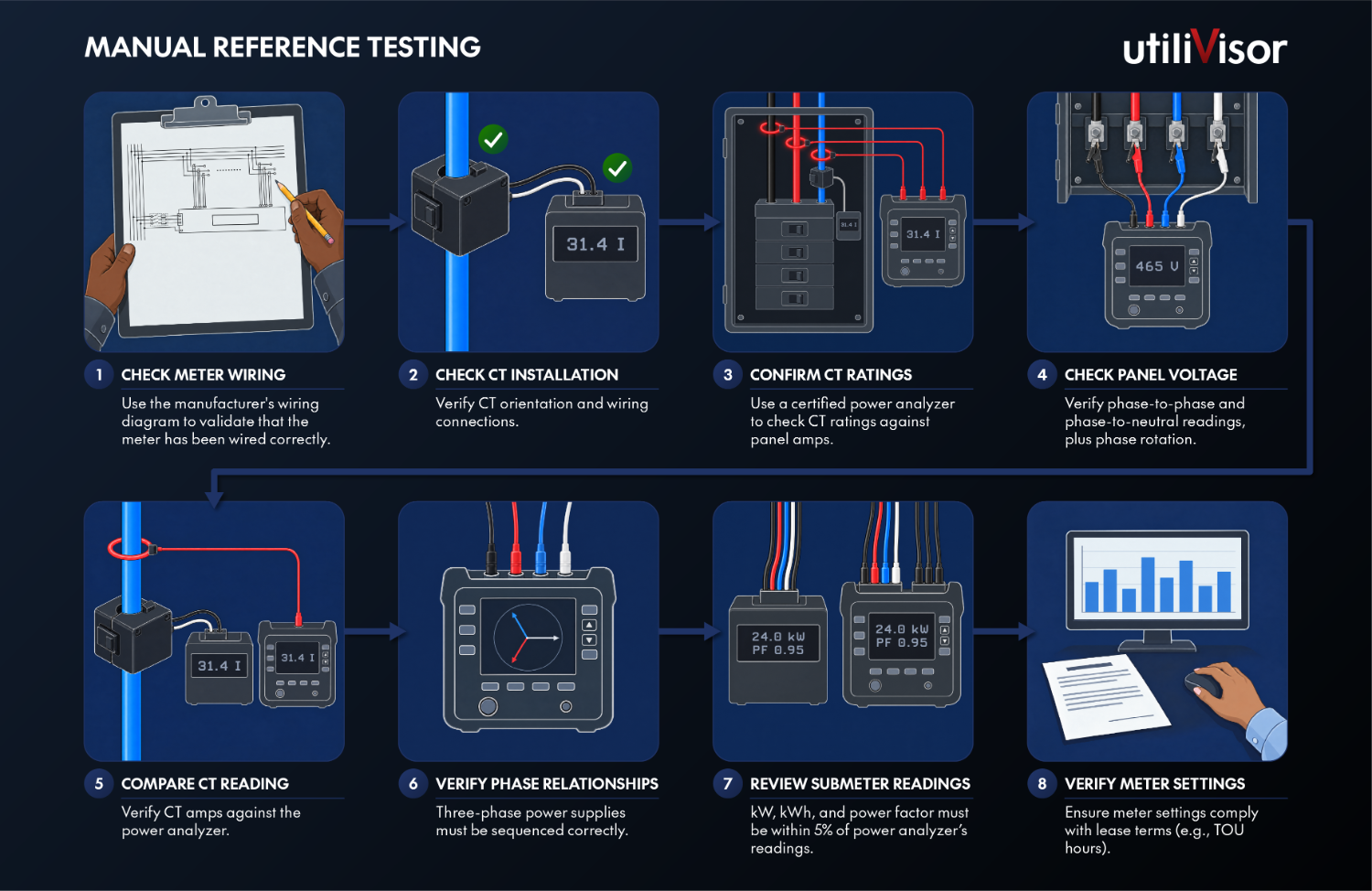
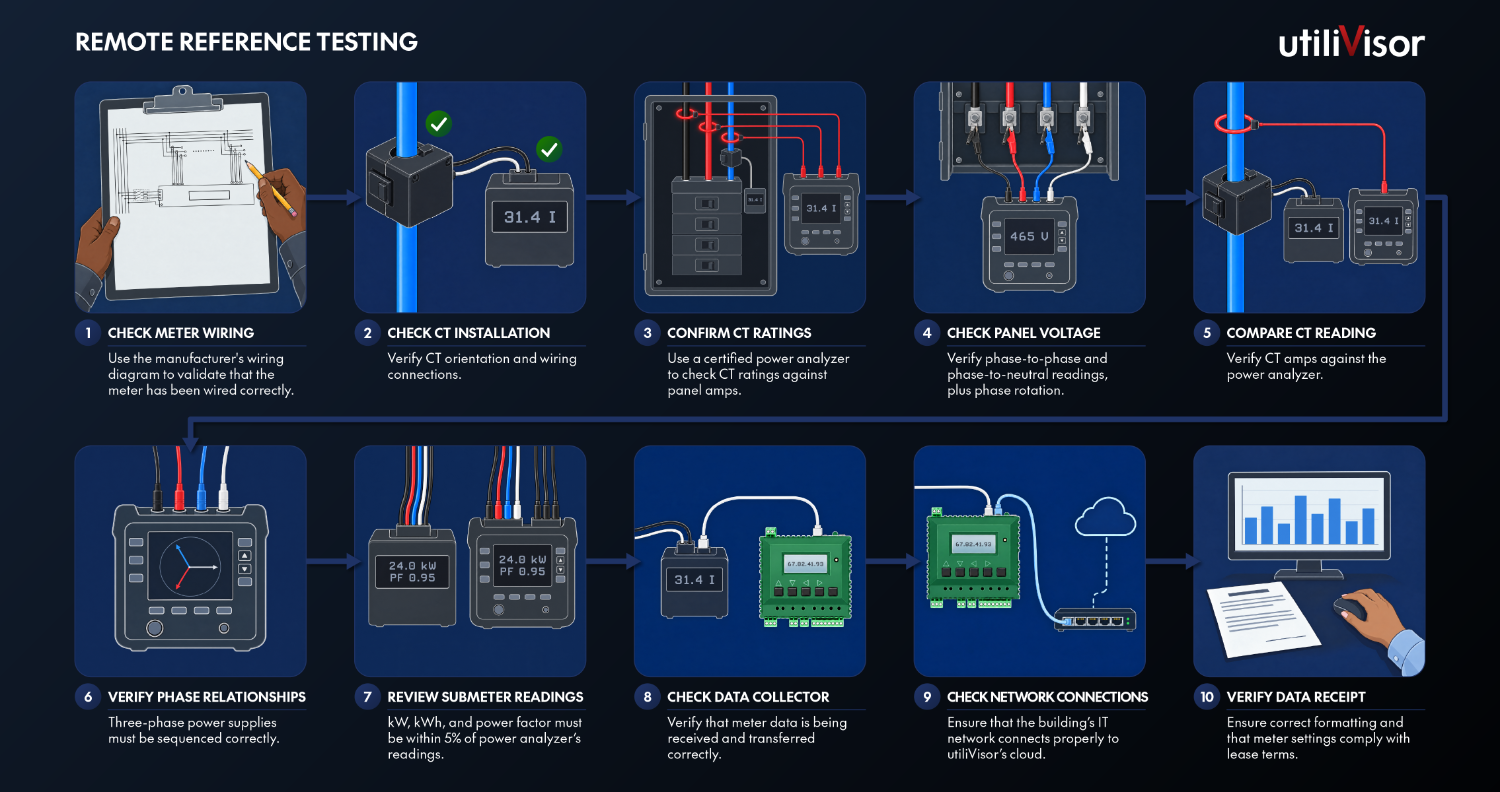
What exactly is reference testing? Thanks for asking! We created some graphics that explain what we mean when we say reference testing and how many ways we check that your meter data is correct (or not).
Let's start with the slightly simpler process for manually read meters. Remote-read meter systems have some additional steps to ensure the data is transmitted and received correctly; otherwise, the process is the same for both types of systems.
How to Verify Manually Read Meters
- Ensure all incoming voltages and power supplies are correct for the meter.
- Confirm that current transformer ratings match panel amperage.
- Check current transformer orientation. Make sure CT arrows are in the direction of the load.
- Check voltage & phase rotation, including phase-to-phase voltage, phase-to-neutral voltage, and phase rotation.
- Compare current transformer readings against portable certified power analyzer.
- Verify correct phase relationship.
- Confirm submeter is displaying the correct kW, kWh, and power factor.
- Confirm that the submeter is programmed to comply with lease requirements (e.g., time-of-use hours).
How to Verify Remotely Read Meters
- Ensure all incoming voltages and power supplies are correct for the meter.
- Confirm that current transformer ratings match panel amperage.
- Check current transformer orientation. Make sure CT arrows are in the direction of the load.
- Check voltage & phase rotation, including phase-to-phase voltage, phase-to-neutral voltage, and phase rotation.
- Compare current transformer readings against portable certified power analyzer.
- Verify correct phase relationship.
- Confirm the submeter is displaying the correct kW, kWh, and power factor.
- Check that the data collector is receiving and transferring data correctly
- Check that the data connection from the building to the cloud is working.
- Verify that remote data is being received and is formatted correctly for analysis.
The value of reference testing is not only knowing that your meter data is accurate but also that you can prove its accuracy. Being able to shut down complaints that the meter readings are wrong and the tenant doesn't owe you that much? That's cash in the bank.
You Might Like
Related articles from our blog:

About utiliVisor
Your tenant submetering and energy plant optimization services are an essential part of your operation. You deserve personalized energy insights from a team that knows buildings from the inside out, applies IoT technology and is energized by providing you with accurate data and energy optimization insights. When you need experience, expertise, and service, you need utiliVisor on your side, delivering consistent energy and cost-saving strategies to you. What more can our 45+ years of experience and historical data do for you? Call utiliVisor at 212-260-4800 or visit utilivisor.com